Team-Wide Pattern Detection: When AI Should Trigger Group Coaching
AI pattern detection flags when 3+ reps make the same mistake on the same deal stage. Here's the threshold framework for triggering group coaching.

TL;DR
AI should trigger a group coaching session when three or more reps make the same mistake on the same call stage within a rolling two-week window. One rep struggling is a 1:1. The whole team missing quota is a strategy problem. The middle layer, shared patterns across multiple reps, is where group coaching pays back. Demodesk's AI Coach scores every call against your scorecard and surfaces these patterns automatically, so managers stop guessing which topic to bring to the next team meeting.
Why most group coaching sessions are wasted
Most group coaching gets scheduled on instinct. A manager hears one rough call, sits in on another, and decides the team needs a session on objection handling. Two reps already nail objection handling. Three needed the session, but on a different objection. One needed help with discovery. The hour gets spent and the scorecards barely move.
This is the coverage-bias problem that breaks 1:1 coaching, at team scale. Managers coach the calls they happened to hear, on the topics they happened to notice. When 73% of managers spend less than 5% of their time coaching, the few hours that do get spent need to land on real patterns, not perceived ones.
Pattern detection fixes the input. Instead of “I think the team is weak on X,” the manager gets “8 of 12 reps scored below 5/10 on discovery question depth across the last 47 calls.” That's a group coaching session worth running.
The threshold: when a 1:1 problem becomes a group problem
Three reps, same gap, same stage, two weeks. That's the trigger.
Two reps with the same gap is usually individual coaching for both, because the root cause often differs: one rep is rushing, the other is asking the wrong question. Three or more, and the pattern usually traces back to something shared. The playbook is unclear, the product training missed a use case, the competitor changed their pitch, or the ICP shifted and reps haven't caught up.
Two weeks is the window because shorter is noise and longer is stale. A rolling 14-day window captures roughly 80–120 calls for a 10-rep team, which is enough volume to separate signal from variance.
The stage matters because “the team is bad at closing” is too vague to coach. “Six of ten reps fail to confirm decision criteria during the second discovery call” is specific enough to run a 45-minute session on. Demodesk's AI Coach scores against the stage definitions in your scorecard — MEDDIC's “Decision Criteria,” Challenger's “Teaching moment,” your custom field — so the pattern arrives pre-categorized.
Five patterns worth a group session, and one that isn't
Worth a group session:
Shared objection, no shared response. Multiple reps hit the same objection — pricing, security, integration. Each handles it differently, and the win rate on calls where the objection lands is below team average. Group session: codify the response, role-play it, ship it back into the next week's calls.
Methodology drift on a specific stage. The scorecard says discovery should cover budget, authority, need, timeline. Across the team, “authority” is being skipped or skimmed. Group session: re-anchor the stage, share two recordings where it was done well, two where it wasn't.
Competitor mention spike with no playbook. The AI Analyst flags that a competitor name appeared in 18 calls last week, up from 4 the week before. Reps are responding ad-hoc. Group session: build the comparison talk track together, push the comparison page link into follow-up templates.
Product update mishandled across the team. A new feature shipped two weeks ago. Calls show it getting under-explained, over-promised, or skipped on relevant deals. Group session: tighten the messaging, walk through the live demo path.
Pipeline-stage handoff failure. SDRs are qualifying deals, but AEs are reopening the same questions on the first call. Group session: align on what “qualified” means, run it across both teams.
Not worth a group session:
One rep with eight gaps. That's a 1:1 problem, even though it looks loud. Coaching it in a group session embarrasses the rep, wastes the team's time, and rarely solves the underlying issue. Pattern detection should filter these out explicitly.
How Demodesk's AI Coach surfaces patterns
Every call gets recorded and scored within minutes against your team's scorecard. The AI Coach scores each rep's calls individually so they get feedback before the next call. The same scoring feeds a team-level view, where pattern detection lives.
The manager dashboard shows three things:
- Score distribution per stage — which stages of the sales cycle are below threshold across the team
- Repeat misses — specific behaviors that 3+ reps got wrong in the last 14 days
- Coaching candidates — a ranked list of topics worth running as a group session, with the underlying calls one click away
The manager doesn't sift through 80 recordings. The pattern arrives with the evidence attached: “These six calls show the gap. Here are two calls from the team that handled it well. Want to use these in tomorrow's session?”
That's how the 1:50 manager-to-rep coaching ratio works in practice. The industry standard of 1:10 assumes the manager is the one finding the pattern. With AI pattern detection, the manager acts on it instead.
Custom scorecards are part of why this works. If your team runs MEDDIC, patterns surface against MEDDIC fields. Challenger, Challenger moves. A custom scorecard for your industry, your fields. The pattern is only as useful as the rubric it's measured against.
What a good group coaching session looks like
Pattern detection gets you to the right topic. The session still needs structure.
The 45-minute format:
- 5 min: name the pattern. Show the data. “8 of 12 reps scored below 5/10 on pricing objection handling in the last two weeks. Here's what the calls look like.”
- 10 min: play two clips. One where the pattern showed up. One where a teammate handled it well. Both pulled from Demodesk recordings, with consent.
- 15 min: role-play. Pair reps up. Run the objection. Switch sides. The reps who handled it well coach the others in real time.
- 10 min: codify. Write the new talk track into the playbook. Push it to the team's shared workspace.
- 5 min: commit to measurement. Next week's pattern report checks whether the score on this stage moved. The session has a measurable outcome, not a sentiment shift.
The measurement loop is what most teams skip. Without it, group coaching becomes a ritual. With it, the manager can open the next session with: “We covered pricing objection handling two weeks ago. Score went from 4.2 to 6.8 across the team. Now here's the next pattern.”
When to trigger 1:1 instead
Pattern detection doesn't replace 1:1 coaching. It routes the work.
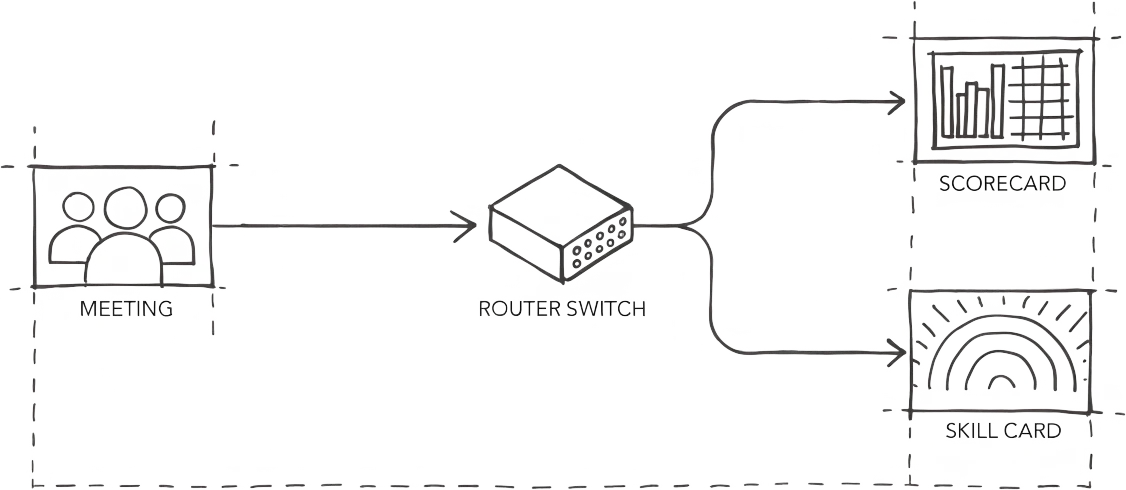
When the AI Coach flags a gap isolated to one rep, the dashboard pushes it into that rep's individual coaching feed, not the group view. The rep gets the feedback after the call, the manager sees it in the next 1:1 prep, and it never hits the team meeting agenda.
The threshold cuts both ways. Below 3 reps with the same gap: 1:1. At or above 3 reps: candidate for group. Above 7 reps: probably a playbook, training, or product-marketing problem that coaching alone won't solve. Pattern detection should escalate these too.